
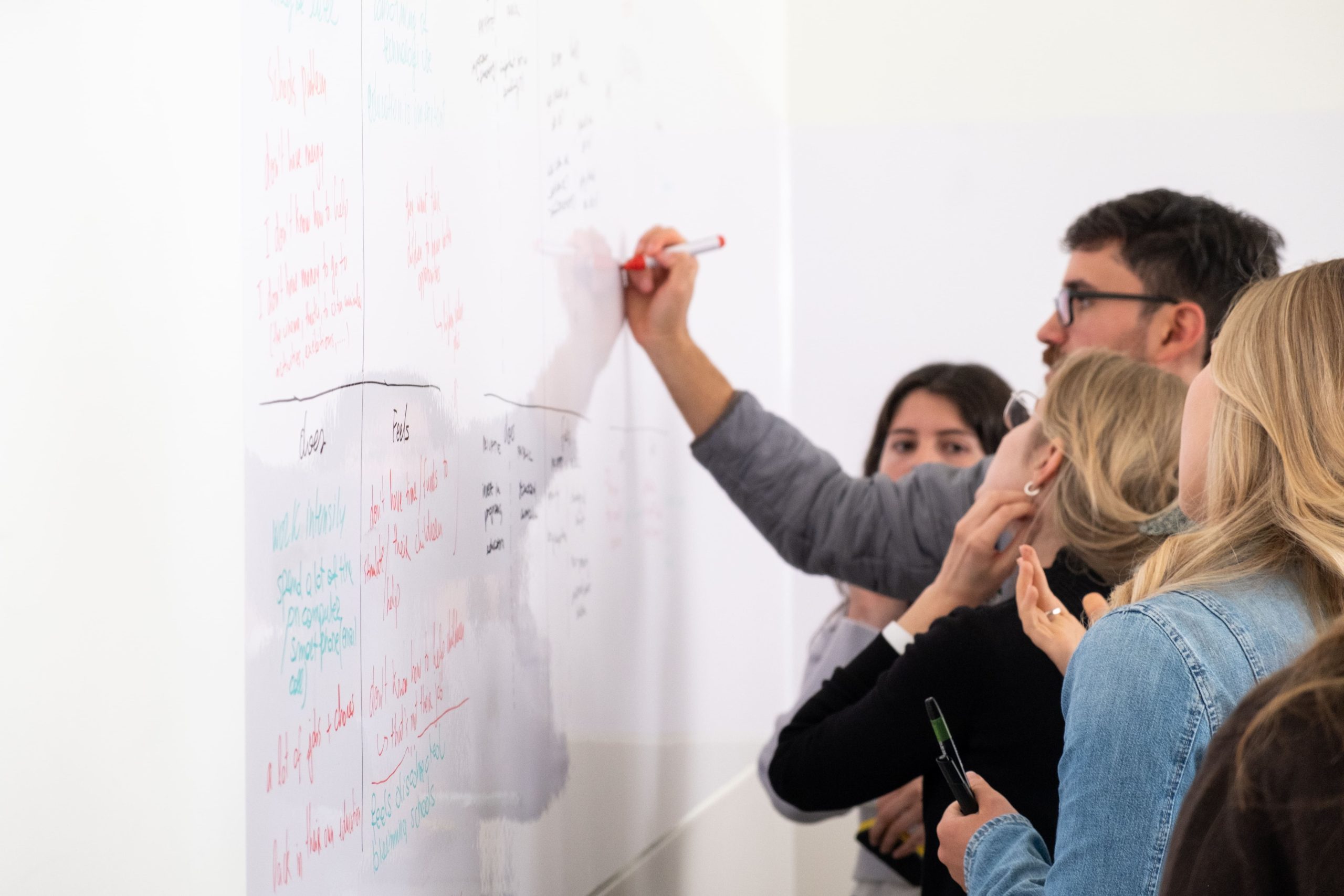
At the core of our education philosophy is the belief that experimenting, collaborating and reflecting are at the core of the learning process. It starts in the classroom, but it continues beyond. Our understanding of the classroom’s boundaries is fluid – inviting professionals, local communities, and other stakeholders to join the conversations and support students’ projects. We offer courses in the Master’s and PhD programs.
Design Thinking for Social Innovation Course
(Spring Semester) Anne-Laure Fayard
This is an experiential project-based course which introduces participants to the value of the design thinking process and a human-cantered approach to social innovation to develop meaningful and sustainable solutions (products, services, communication, processes etc.) Such an approach highlights the complexity of many social issues and the need for interconnected and systemic responses.
Designing for social innovation requires taking a system approach that involves multi-disciplinary collaboration and engagement of all stakeholders including the end-users or beneficiaries. Through multiple activities, mini-challenges, and a semester-long project, the course invites participants to experience the whole design innovation process (researching, ideating, prototyping, testing, communicating, and implementing) with a focus on developing and sustaining social innovations.
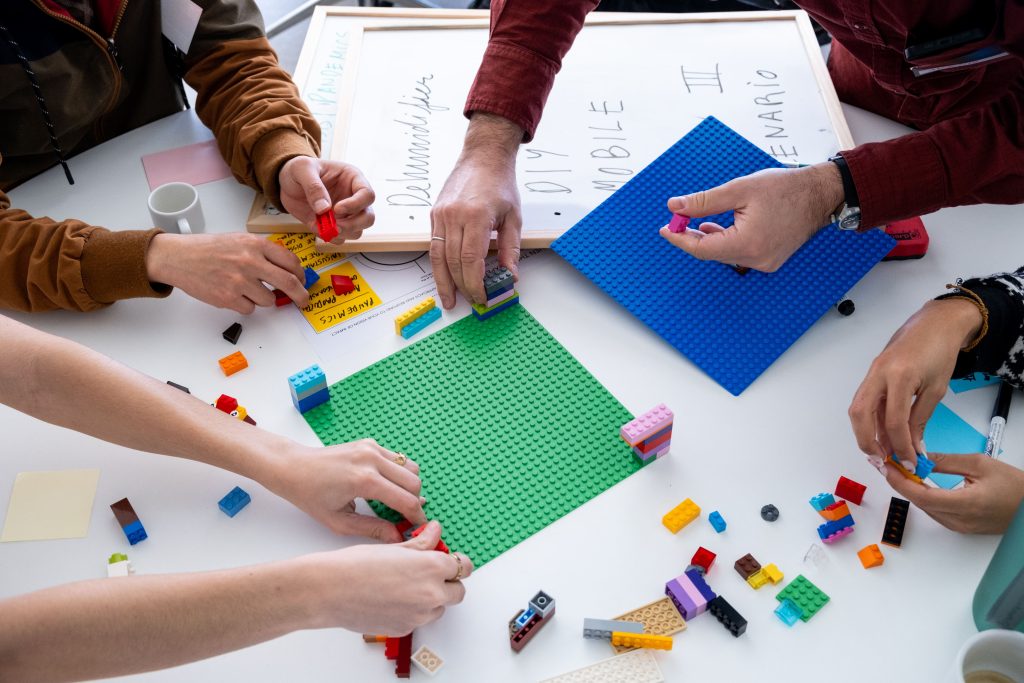
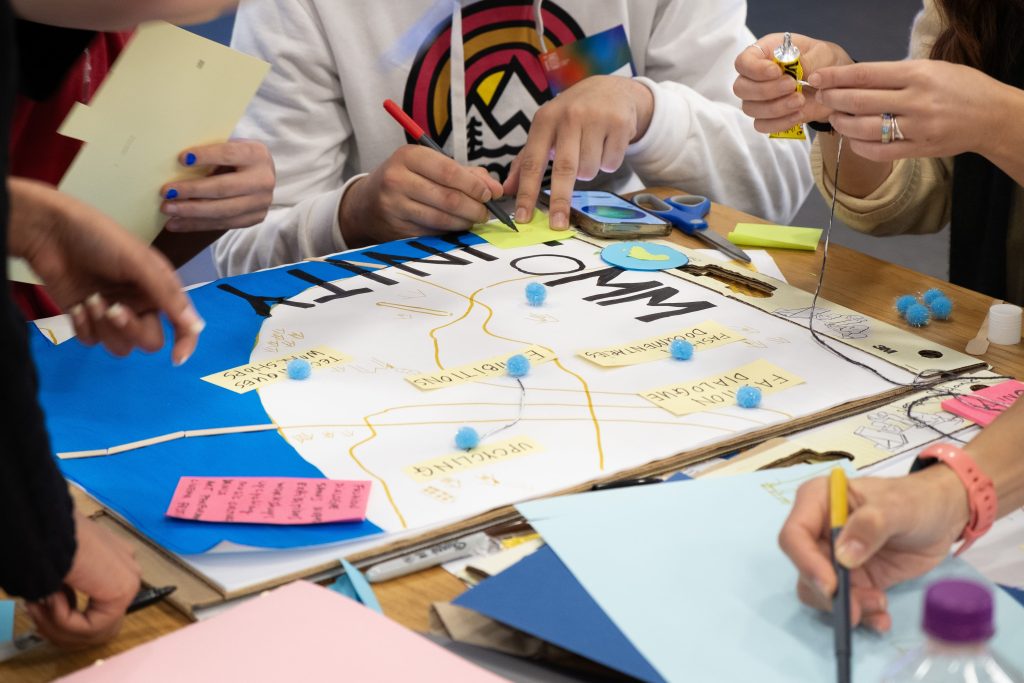
Becoming a Change Maker
(Fall Semester) Anne-Laure Fayard
Conceived as a steppingstone in the Master’s in Impact Entrepreneurship and Impact’s learning journey, this course is designed to provide students with toolkit of methods and skills that they can use in their MIEI projects and in their life more broadly.
It provides students with tools and an environment to explore what it takes to make positive impact. It gives students (whether entrepreneurs or intrapreneurs) the space to explore their individual theory of change, develop change maker mindset, and explore tools for imaging desirable futures.


Power in Social Change
(Spring Semester) Samantha Ortiz Casillas
Elective course for students interested in how power is exercised by people and organizations to bring about social change. The course combines theoretical insights with practical examples and discussions to help students understand power and social change across the private, public, and civil sectors. It gives students analytical tools they can apply in social change projects and their everyday lives.
The course features classical as well as critical approaches on power, politics, public policy, social movements, and organizing to provide students with a holistic understanding of the possibilities, promises, and challenges of social change. Active participation, deep reflection, and in-class discussion are essential elements in this course.
Research methods in Management
(Spring Semester) Samantha Ortiz Casillas
Mandatory course introducing students to how research is conducted in management. Over six classes, students learn key research steps, including how to read literature, develop research questions and hypotheses, understand qualitative and quantitative methods, and critically assess existing research and methodological choices. The course also teaches effective communication of research findings and provides foundational scientific literacy for thesis development.
The course features classical as well as critical approaches on power, politics, public policy, social movements, and organizing to provide students with a holistic understanding of the possibilities, promises, and challenges of social change. Active participation, deep reflection, and in-class discussion are essential elements in this course
Open Innovation
(Spring Semester) Paolo Leone
The course prepares students for managing innovation in a democratized landscape, where both producers and individual entities contribute to the evolving innovation paradigm. It covers open and user innovation, exploring how emerging models impact value creation amid technological shifts.
Students are invited to examine how organizations navigate internal and external knowledge sources, addressing challenges in optimizing processes for systematic benefit. Through real-world examples, the course aims to provide insights into organizing open and user innovation effectively. Students will gain tools to identify successful open innovation approaches in markets and capitalize on them in entrepreneurial and established firms.
Organizing for Good in the Digital Age
(Spring Semester) Paolo Leone
During the course, the concept of the “good organization” is explored and how organizations, teams, and individuals can contribute to addressing the grand challenges of our time. Organizing for Good in the Digital Age is an interactive class aimed at collaboratively developing an understanding of what it means to do good and how organizations can focus on ethical practices.
P.h.D research seminar on qualitative methods: Field Methods and exploratory data analysis – PhD Seminar offered by Anne-Laure Fayard
This course provides a “how-to” of ethnographic research. Students will conduct an ethnographic project of their own, complemented by weekly readings and discussions. It deals in an applied way with two interrelated topics: Field methods of research (in particular observations and interviewing) and exploratory data analysis (i.e. inductive analysis; grounded theory).In this course participants will read and discuss many examples of published field research.
In addition, they will be given ample opportunities to learn from their own mistakes as they design and conduct a small field research project. There will be methodological readings as well but, for the most part, these will be of secondary importance to one’s own learning by example and learning from experience.
Philosophy and Theory in Management Research – PhD Course offered by Paolo Leone
This course introduces the philosophical and theoretical underpinnings of management research. The course aims to familiarize students with the core philosophical and metatheoretical issues and controversies that underlie the practice of management research as a social science.
In that it seeks to sensitize students to the essential choices they will be called upon to make as researchers. The course also illustrates the key role of theory and theorizing in management research, guiding students as they craft a conceptual paperuring the course, the concept of the “good organization” is explored and how organizations, teams, and individuals can contribute to addressing the grand challenges of our time. Organizing for Good in the Digital Age is an interactive class aimed at collaboratively developing an understanding of what it means to do good and how organizations can focus on ethical practices.
Qualitative Research Methods Workshop
Qualitative research methods bring us closer to the organizations and the social action that we study. Using these methods, scholars can develop rich, relevant, and more interesting contributions to organizational theory.
Since 2022, the ERA Chair in Social Innovation has been supporting the Qualitative Methods Workshop, an intensive 4-day experiential workshop in qualitative research methods at NOVA SBE. It was offered in June 2022 and June 2024 and will be offered again in June 2026.
The goal of this workshop, open to doctoral students, post-doctoral fellows and early-career faculty, is to provide project-based, interactive training in qualitative research methods and build community and networks across qualitative researchers. In each of the first two editions, we hosted about 25 participants from top international schools: Harvard, MIT, UCLA, NYU, McGill, Oxford, Cambridge, ESSEC, VU, etc.
In the first 2 editions, Anne-Laure Fayard joined forces with 4 other international experts in qualitative methods, Beth Bechky (UC Davis), Ruthanne Huising (ESSEC), Melissa Mazmanian (UC Irvine) and Hila Lifshitz-Assaf (Warwick). For the 2026 edition, the organizing team is composed of Anne-Laure Fayard, Beth Bechky and Sam Ortiz Cassillas (Nova SBE) who will be joined by 3 guest faculty.
Learn more about the Qualitative Methods Workshop here
Testimonials
“Thank you so much for all the effort you put into crafting and facilitating this workshop. I am walking away from the experience with greater confidence in my methodological training, a renewed sense of conviction in my chosen methods, and invaluable connections with my peers in the qualitative community. I am so grateful to you all for taking it upon yourselves to provide this opportunity to emerging scholars and for putting so much thought into the tone, content, and structure of the workshop.”
“This workshop helped develop, grow, and mature my approach to qualitative research. First, this course gave me a new appreciation for how long it takes to do qualitative research. Second, it gave me confidence that uncertainty and feeling lost is part of the process. (…) Qualitative research requires perseverance, patience, curiosity, imagination, flexibility, and playfulness – all attributes I hope to demonstrate in my future work.”
“Thank you for a wonderful workshop last week. I learned an incredible amount from each of you that I am already putting to use on my dissertation research. Your presentations each morning were exceptionally useful in helping me to reflect on where I can improve my techniques/ approach to this work, and your incredibly generous one-on-one advice in the afternoon Q&As, over lunch, or in our team breakouts offered some very generative thinking points for me. I have been combing through my pages of notes to make sure I apply all of these lessons in the coming months/years.”
Projects
During the year we work on a diversity of projects.
DESIS Lab
Learn more about the DESIS Lab @ NOVA SBE.
Mentors
Discover the mentors of the DESIS Lab @ NOVA SBE.